Portrait
Elisabeth de GOURCUFF began educating herself while a teenager in Paris.
Convinced of the need to seek creative inspiration in the study of ancient art and civilizations, she attended the Ecole du Louvre where she refined her understanding of major classical masterpieces.
She then joined the Albers’s studio in Paris and prepared herself for the best art schools. She entered the Royal Academy of Fine Arts in Brussels where she received a classical training in such techniques as plaster and clay sculpting, granite carving and bronze casting.
She returned to France to spend two years in the workshop of Montmartre sculptor Marcel Mahu.
During this period, she also taught drawing at the Association for the Development of Plastic Arts.
In 1992 she began working in private studios in Paris and the Berry region. In 1995, she enrolled in classes to study printmaking in the workshops on the Place des Vosges and stone carving at the Paris School of Fine Arts – Beaux-Arts.
In 1998 she settled in the Berry where she has since concentrated on her wildlife bronzes, as well as statues and busts in bronze and plaster. In addition, she continues to meet the demands of an ever increasing number of commissions.
Since 2010 she works in Angers, Paris, Santiago (Chile) and Milan (Italy)
The creative process
Mastery of Form and Technique in the Service of Art
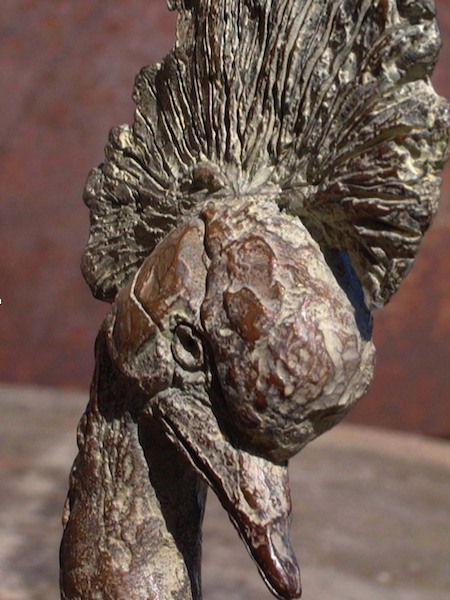
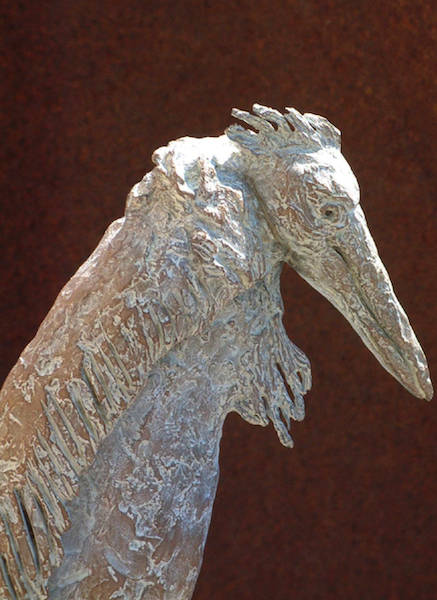
Skirting the major 20th century trends in wildlife bronzes, Elisabeth de GOURCUFF has successfully developed a thoroughly personal style. With its dynamic quality, her work defies the weight of bronze and displays subtle touches in a mixture of graphic elements, light and matter.
Meticulous supervision of all stages of founding and casting has allowed her to achieve a degree of delicacy and quality in her work that is largely responsible for her reputation today.
A Very Personal Style
From the very beginning of her career, Elisabeth de GOURCUFF has shown a fondness for feathered animals in her work.
A lighter-than-air fluidity, extravagant lines; gravity-defying movement; and anthropomorphism characterize Elisabeth de GOURCUFF's work and style. These defining elements are ubiquitous in her small-scale and monumental work, both of which show an equal attention to detail, lightness of form and delicacy of rendering.
Casting birds in bronze gives them the timeless quality she seeks to convey.
She draws inspiration from a wealth of sources, including nature, dreams, poetry and paintings. Formative travels have helped shape her vision and enrich her knowledge of animals in their native environments.
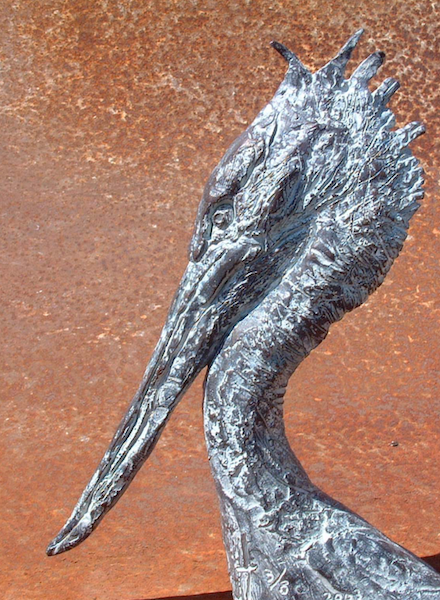
In contrast to the 20th century trend towards smooth, highly polished wildlife bronzes, Elisabeth de GOURCUFF has created a distinct body of work with a nearly impressionistic, idiosyncratically coarse look and feel.
Catching the light with a twofold effect of vibrant strokes and dexterous carving of the medium, Elisabeth de GOURCUFF breathes life and movement into her work, infusing it with a jubilant physical presence while never indulging the clichés of genre painting.
Shunning the simplified or abstract style of such artists as Brancusi, Elisabeth de GOURCUFF's carefully detailed animals are captured in the flesh, almost humanly alive.
Beyond mere depiction of a scene, Elisabeth de GOURCUFF's sculptures are a revelation, a tribute to the world of birds in all their splendor. She shows us as never before the irresistible charms and modernity of these animals, many of which have endured since pre-historic times.

Execution
The Artist's Complete Technical Mastery
In addition to her signature focus on birds, Elisabeth de GOURCUFF has set herself apart through a wide-ranging creative versatility, bolstered by a solid command of sculptural techniques.
Beyond her passion for bronze, she expresses herself through other materials such as stone, granite, marble, wood, or heat-resistant plaster which she uses for sculpting and carving.
For designs that are to be cast in bronze, she uses many materials including clay, wax or wood, steel, stone or plaster, depending on the effect desired.
Elisabeth de GOURCUFF is involved in every step of the creation of her bronzes, including all the techniques and refinements in the formulating of the specific solutions critical to achieving the delicacy of her pieces.
She participates in the verification of the lost wax, the assembly of the pieces, in the creation and control of the chiseling and in the making of often innovative coatings.
The innovativeness of Elisabeth de GOURCUFF’s work can be attributed to a sweeping sensibility. She is one of the few artists today who has chosen to specialize in the subject matter of birds. Through this emphasis, her body of work has become part of the history of wildlife sculpture. She will eventually have produced the largest collection of bird bronzes ever recorded.
Her technique of fine strokes, graphics and salients, is particularly original and immediately identifiable as highly distinctive.
This mixture of realism and timelessness inherent in her work imbues her creations with a unique aura, which strangely echoes back a century to the work of Rembrandt Bugatti.
Continuity and Originality
The innovativeness of Elisabeth de GOURCUFF’s work can be attributed to a sweeping sensibility. She is one of the few artists today who has chosen to specialize in the subject matter of birds. Through this emphasis, her body of work has become part of the history of wildlife sculpture. She will eventually have produced the largest collection of bird bronzes ever recorded.
Her technique of fine strokes, graphics and salients, is particularly original and immediately identifiable as highly distinctive.
This mixture of realism and timelessness inherent in her work imbues her creations with a unique aura, which strangely echoes back a century to the work of Rembrandt Bugatti.